CRUDLookup
CRUDLookup is a configuration object used by CRUDRouter to define a related child collection.
It does not create routes by itself. Instead, you pass it to CRUDRouter(lookups=[...]), and the router layer uses that configuration to build nested child routes.
Constructor
CRUDLookup(
    model: MongoModel,
    model_out: MongoModel,
    collection_name: str,
    prefix: str,
    local_field: str,
    foreign_field: str,
)
When used with CRUDRouter, it is intended for parent-child relationships such as:
/users/{id}/messages/users/{id}/messages/{lookup_id}
When to Use CRUDLookup
CRUDLookup is useful when:
- child documents are stored in a separate collection
- each child references its parent with a foreign key (for example,
user_id) - you want nested REST endpoints without writing all child routes manually
Parameters
model: child model class used for lookup documentsmodel_out: output model used for lookup responsescollection_name: MongoDB collection containing child documentsprefix: nested route segment used in URLslocal_field: parent field used for matching, often_idforeign_field: child field pointing back to the parent id
All constructor arguments are required in the current implementation.
Parent Model Shape
When using lookups with CRUDRouter, the parent model is typically shaped to expose either a list of child documents or a single child document:
from typing import Optional, Union
from fastapi_crudrouter_mongodb import MongoModel, ObjectIdType


class ChildModel(MongoModel):
    id: ObjectIdType | None = None
    parent_id: ObjectIdType


class ParentModel(MongoModel):
    id: ObjectIdType | None = None
    childs: Optional[Union[list[ChildModel], ChildModel]] = None
This shape is useful because:
- list form supports routes returning many children, such as
/parents/{id}/childrens - single object form supports routes returning one child, such as
/parents/{id}/childrens/{lookup_id}
Quick Setup
from typing import Optional, Union
from fastapi_crudrouter_mongodb import (
    CRUDLookup,
    CRUDRouter,
    MongoModel,
    ObjectIdType,
)


class ChildModel(MongoModel):
    id: ObjectIdType | None = None
    parent_id: ObjectIdType


class ChildModelOut(MongoModel):
    id: str
    parent_id: str


class ParentModel(MongoModel):
    id: ObjectIdType | None = None
    childs: Optional[Union[list[ChildModel], ChildModel]] = None


child_lookup = CRUDLookup(
    model=ChildModel,
    model_out=ChildModelOut,
    collection_name="childrens",
    prefix="childrens",
    local_field="_id",
    foreign_field="parent_id",
)

parents_router = CRUDRouter(
    model=ParentModel,
    db=db,
    collection_name="parents",
    lookups=[child_lookup],
    prefix="/parents",
    tags=["parents"],
)
Output Schemas
CRUDLookup requires a model_out argument in the current implementation.
Use it to control the response shape returned by nested lookup routes.
- hide sensitive fields from child responses
- return ids as strings instead of raw MongoDB values
- keep nested route responses separate from the database model shape
from datetime import datetime
from typing import Optional, Union
from fastapi_crudrouter_mongodb import CRUDLookup, CRUDRouter, MongoModel, ObjectIdType


class MessageModel(MongoModel):
    id: ObjectIdType | None = None
    message: str
    user_id: ObjectIdType
    created_at: str | None = datetime.now().strftime("%Y-%m-%d %H:%M:%S")
    updated_at: str | None = datetime.now().strftime("%Y-%m-%d %H:%M:%S")


class UserModel(MongoModel):
    id: ObjectIdType | None = None
    name: str
    email: str
    password: str
    messages: Optional[Union[list[MessageModel], MessageModel]] = None


class MessageModelOut(MongoModel):
    id: str
    message: str
    user_id: str


messages_lookup = CRUDLookup(
    model=MessageModel,
    model_out=MessageModelOut,
    collection_name="messages",
    prefix="messages",
    local_field="_id",
    foreign_field="user_id",
)

users_router = CRUDRouter(
    model=UserModel,
    db=db,
    collection_name="users",
    lookups=[messages_lookup],
    prefix="/users",
    tags=["users"],
)
What CRUDLookup Defines
When passed to CRUDRouter, a CRUDLookup object defines:
- which child model is used
- which output model is used for child responses
- which child collection is queried
- which URL segment is used for nested routes
- how the parent and child documents are matched
In the example above:
prefix="messages"produces nested routes under/users/{id}/messageslocal_field="_id"means the parent user id is the local match fieldforeign_field="user_id"means each message points back to the user throughuser_id
Typical Nested Routes
When one lookup is attached to a router, the resulting API commonly includes routes like these:
| Route | Method | Description |
|---|---|---|
/parents |
GET |
Get all parent documents |
/parents |
POST |
Create a parent document |
/parents/{id} |
GET |
Get a parent document by id |
/parents/{id} |
PUT |
Replace a parent document by id |
/parents/{id} |
PATCH |
Partially update a parent document by id |
/parents/{id} |
DELETE |
Delete a parent document by id |
/parents/{id}/childrens |
GET |
Get all children for a parent |
/parents/{id}/childrens/{lookup_id} |
GET |
Get one child for a parent |
/parents/{id}/childrens |
POST |
Create a child under a parent |
/parents/{id}/childrens/{lookup_id} |
PUT |
Replace a child by id and lookup id |
/parents/{id}/childrens/{lookup_id} |
PATCH |
Partially update a child by id and lookup id |
/parents/{id}/childrens/{lookup_id} |
DELETE |
Delete a child by id and lookup id |
Route Naming
Use plural prefixes (for example, /parents, /messages) for cleaner REST-style URLs.
Notes
- The current
CRUDLookupclass is a simple container for lookup configuration. - The class itself does not validate parameter values.
- Route generation happens when the object is passed to
CRUDRouter.
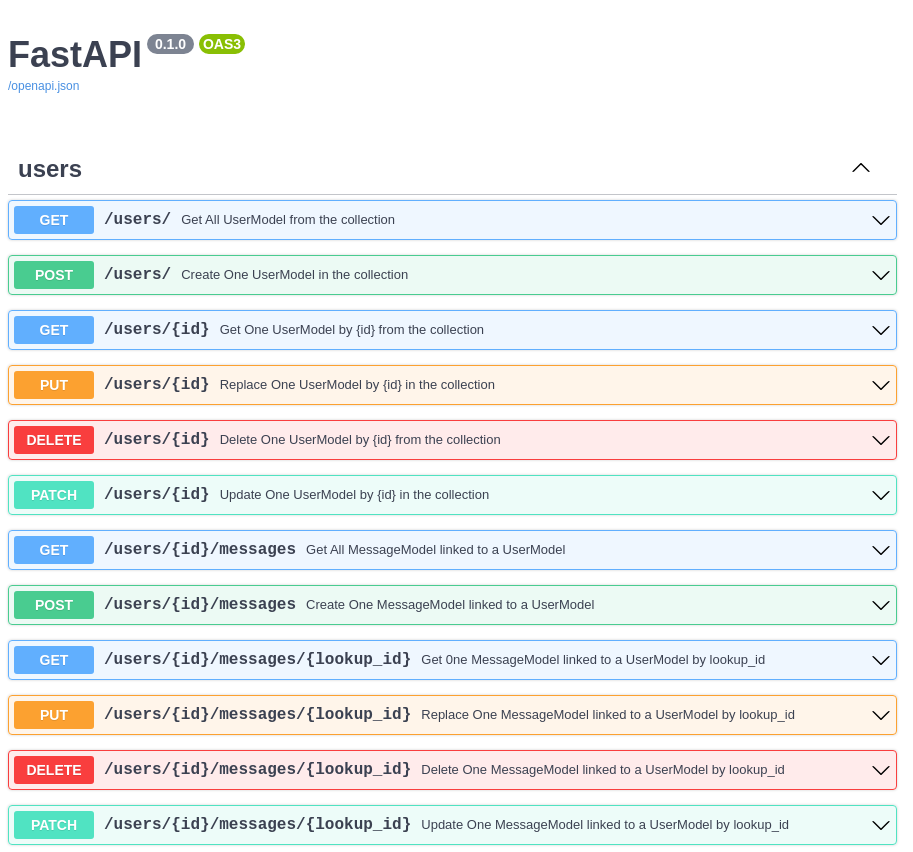
OpenAPI Documentation
Nested routes generated through CRUDRouter are included in the normal FastAPI OpenAPI output.
Related Features
- CRUDRouter: base CRUD routes and router-level options
- CRUDPopulate: resolve referenced ids into full documents in responses
- CRUDEmbed: work with embedded models